As part of my 8th Semester Thesis, I explored the decentralisation of power within concentrated systems through the lens of Karnataka’s coffee supply chain.
This led to Kappeee, a flexible SaaS platform that connects specialty coffee stakeholders through a blockchain-powered shared ledger, enabling greater visibility, traceability, and coordination from farm to cup. The platform also transforms supply-chain data into compelling consumer stories, helping producers gain greater recognition.
PROJECT BRIEF
Project Type
Service Deisgn, UX, Blockchain
Team
Individual
Timeline
16 Weeks
PROJECT at a glance
Mapping the Coffee Supply Chain to uncover Systemic Gaps
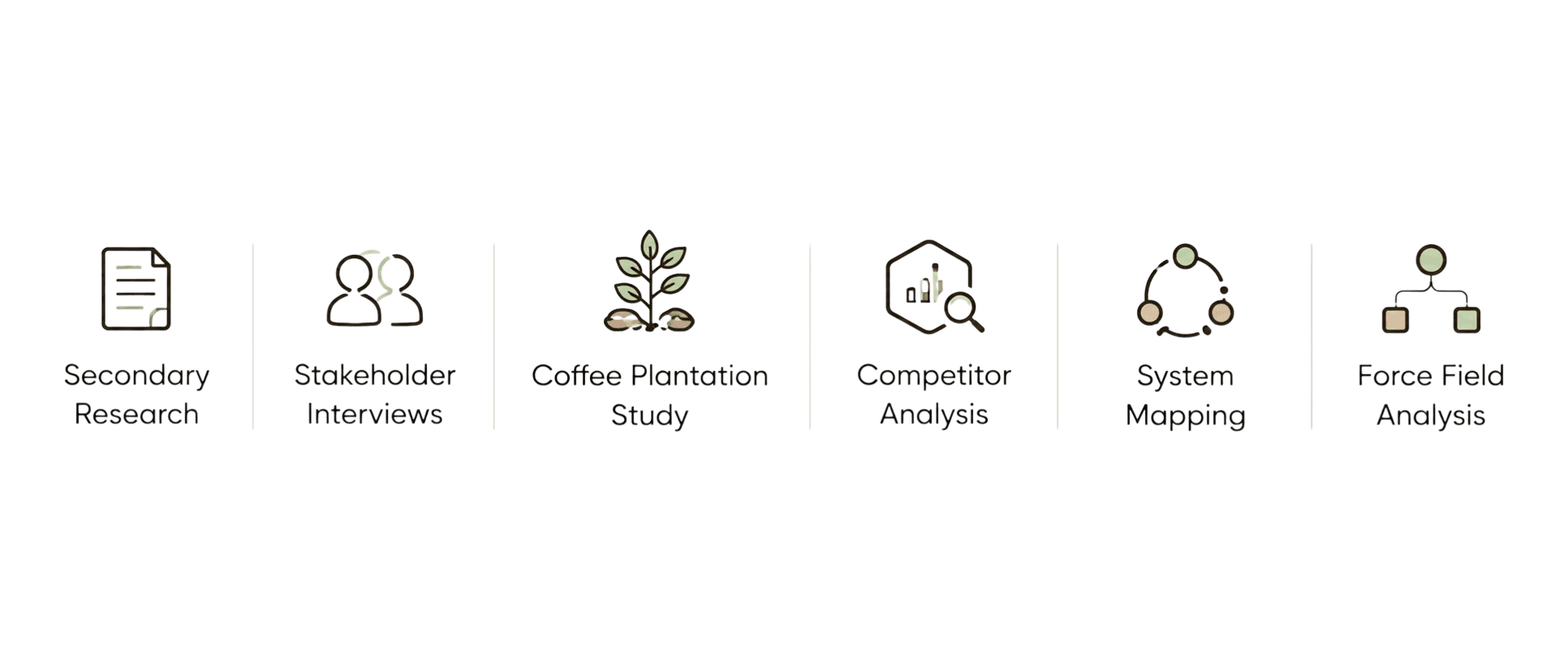
Through secondary research, stakeholder interviews, coffee plantation studies, competitor analysis, system mapping and force-field analysis, I identified:
Fragmented and siloed information
Limited supply-chain visibility
Delayed problem detection
Poor traceability and accountability
I translated these opportunities into Kappeee, a flexible SaaS platform that creates a shared ledger across coffee stakeholders. The concept enables greater visibility, traceability and coordination from farm to cup, while transforming supply-chain data into consumer-facing stories — traceability QRs on coffee packaging
I developed and tested the platform concept across system architecture, data flows, stakeholder relationships and user flows, while prototyping the working interface and backend through iterative, AI-assisted development.
View Solution
View Docbook
Translating System Gaps into a Blockchain-powered Service
Building the System around Kappeee
Impact of the Implementation of the Kappeee Platform

Understanding & Dissecting the Brief
Empathizing through Research
Defining Problem Statement
Ideation & Iteration
Design & Prototype
Validation & Testing
Validation Interviews
Secondary Research
Competitor Analysis
My Blockchain Position
Coffee Plantation Study
Force Field Analysis
Semi Structured Interviews
Research on Coffee Supply Chain, Coffee Farmers & Black Baza’s Model
User Personas
System Mapping
Power Asymmetry in SC
Core Values for the Project
Final Problem Statement
The Disney Strategy
SCAMPER
Value Proposition Canvas
Final Idea for Design Intervention
Strategy Plane
Scope Plane
SWOT Analysis
User Flows
Wireframing
Information Architecture
Data Flow Diagram
UI ideation
Brand Strategy
Prototype & Vibecode
User Testing with Prototype
System Analysis
16 Weeks
DESIGN PROCESS
01/ THE BIGGER QUESTION
Systems are built to keep things running smoothly. But over time, they can also create power asymmetries and unequal access to opportunity.
Power Center
Information
Opportunity
Access
Control
What happens when
power is concentrated?
02/ One bean, many hands
India is 7th largest coffee producer in the world
Karnataka , Kerala, Tamil Nadu account for 96% of the country’s coffee production
Coffee is an economically significant crop, with export value of USD 1.29 billion

ABout the Speciality Coffee Supply Chain in india
The current coffee supply chain: system map (HOVER TO ZOOM)
The System and Pain Points of the Coffee Supply Chain

Farmer
Processor
Roaster
Retailer
Consumer
Where the System breaks - The Problems
Siloed Documentation
Fragmented Monitoring
Delayed Problem Detection
Poor Coordination
Limited End-to-End Visability

03/ Seeing The System through people

Ananya G - Coffee Retailer
Problems/Stressors:
Delays in Delivery
Limited Visibility into Upstream processes
Takes time to detect problems
Difficult Interoperability

Nehal S - Traceability Officer
Problems/Stressors:
Difficult to contact farmers — they dont have Wi-Fi
Errors in Traceability are Expensive
Takes time to detect problems

Vimala S - Coffee Farmer
Problems/Stressors:
Reliance on Middlemen
Limited visible into downstream
Limited visibility about price
Limited Digital Literacy
Ramesh G - Coffee Processor
Problems/Stressors:
Fragmented inputs
Siloed Communication
Complex Documentation
Delays in transport
Limited Tracking Visiblity

Arjun M - Coffee Roaster
Problems/Stressors:
Product inconsistencies
Limited visibility into upstream
Coffee Wastages
Manual Record keeping

Sachin - Coffee Drinker
Problems/Stressors:
Price point too high
No provenance of product
Lack of information about coffee

Meet the coffee stakeholders
The User personas:
04/ Research that changed my direction
rESEARCH METHODS USED
Delayed issue detection (14–21 days)
Traceability errors are expensive to resolve
Manual data collection makes systems slow and error-prone
Middlemen cannot be eliminated
Farmers are hard to reach due to low connectivity
44% farmers use smartphones
Technology exists, but operationalization is the biggest hurdle
Lack of regulation & compliance
Specialty coffee more suited for traceability systems
I conducted my research with the following coffee stakeholders:
Arishya Bose
Retailer
Himija Relangi
Traceability Officer
Meghana Satish
Retailer
Jaishree S
Coffee Board
Srivatsa Sreenivasarao
Blockchain Professional


Research fINDINGS
How might we bring all stakeholders in Karnataka’s speciality coffee supply chain together to provide greater shared visibility and improve coordination?
05/ From Research to opportunity
The Problem Statement
Key OpportunitY Areas
Key OpportunitY Areas

06/ Decentralisation Approach

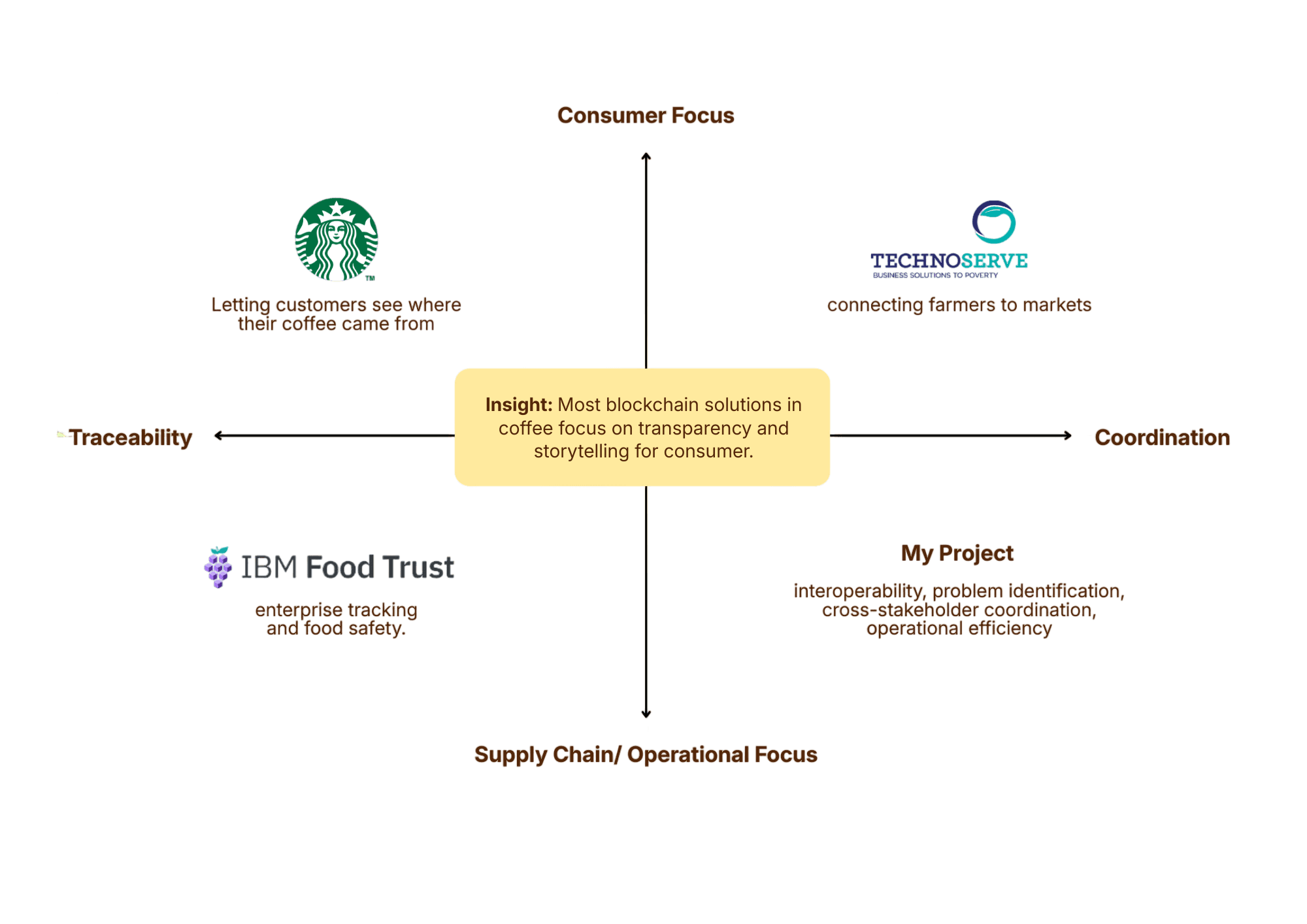
Other companies have introduced blockchains for customer-facing storytelling
My Blockchain focuses on Decentralisation, transparency, Optimization and improving operations in the backend
What is Blockchain?
Blockchain is a distributed ledger of data that is transparent, immutable, secure, and decentralised. It is literally a chain of blocks where each block contains certain data, and they are chained in such a way that they are not easy to break.
WHY BLOCKCHAIN?
GG
The platform was prototyped using figma and then vibe-coded using Claude & Codex — This was my first time coding, and I made a real, functional, working application running on a PostgreSQL database with Supabase for authentication and real-time data. I was mentored and guided through this process by Rajeev Kesena.





Introducing KAPPEEE
G
Kappeee's vision is to eliminate data silos, enable real-time problem detection, and make the coffee supply chain fully traceable — so every stakeholder operates on the same verified information from farm to cup.
Kappeee is a flexible SaaS platform that unites Karnataka’s speciality coffee stakeholders on a shared blockchain-powered ledger, enabling greater visibility, improved problem detection, coordination, and traceability from farm to cup.
How does Kappeee Platform work:
made by many, seen by all
07/ The DESIGN inTERVENTION
Features + How Does Kappeee Work?
1. Role-based Onboarding
2. Role based Dashboard
3. Batch Creation
4. Batch Progression & Handoff
5. Batch Data Input
Messages
Issue Flagging
Metric Tracking
Decentralised Ledger
Consumer Traceability QRs
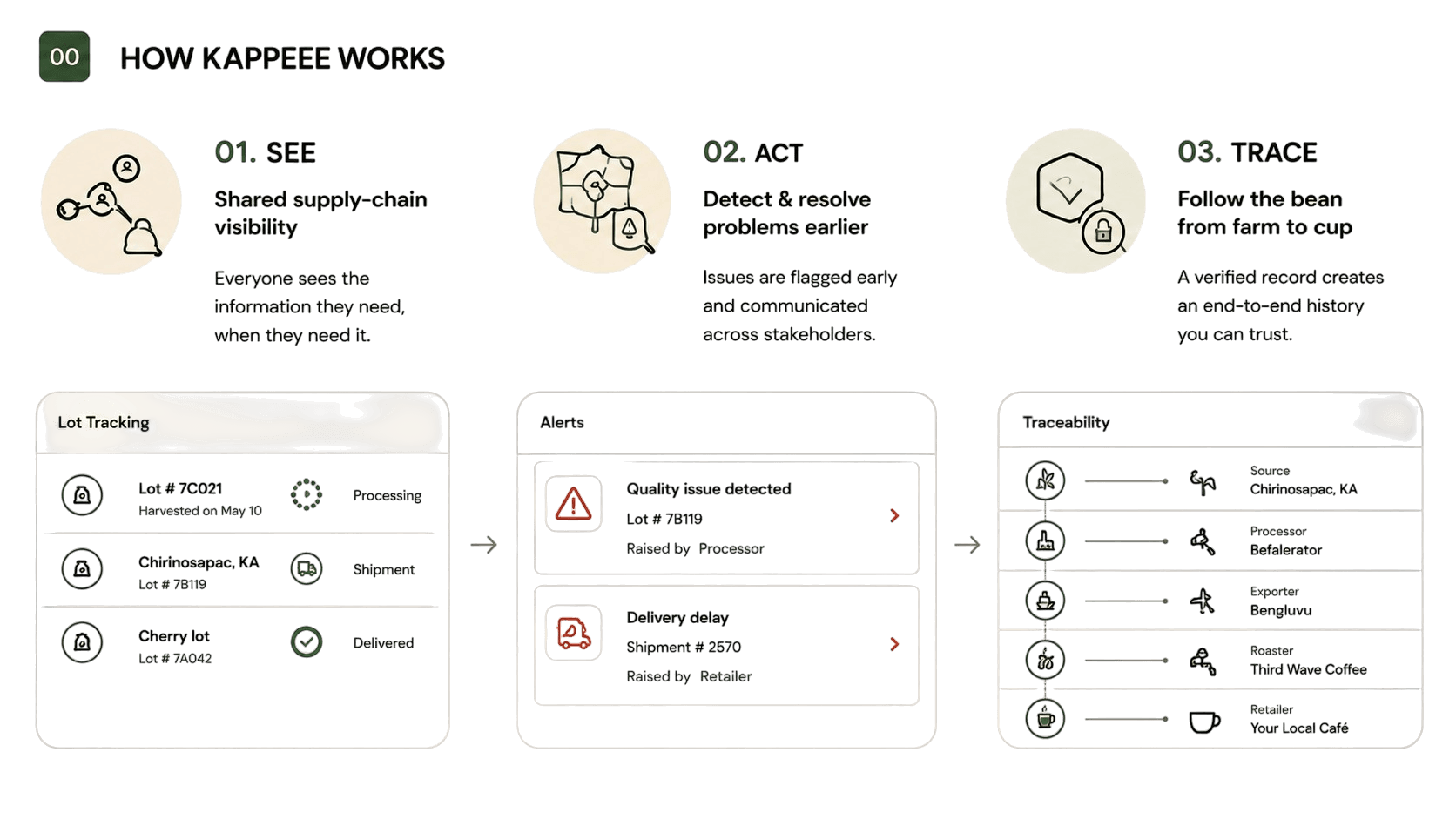
Lot tracking
Alerts
Traceability

1) Role Based Onboarding
2) Retailer raises an Order to Stakeholders, data is stored in the blockchain ledger
3) Farmer Accepts Order, does Data Input & Passes order on to the processor. Data is stored in the blockchain ledger
4) Processor Accepts order, does data input & passes it on to the Roaster. Data is stored in the blockchain ledger
5) Roaster accepts the order, does data input & passes it on to the Retailer again for final Assessment. Data is stored in the blockchain ledger
6) Retailer reviews and does the final review and completes the order. Data is stored in the blockchain ledger
7) After the order is completed, the blockchain data is transformed into tracebaility QR's
Incase of any issues users can flag on the platform, adjust blockchain entries using the ammendent form, communicate and sort out issues and verify everything via the Blockchain ledger


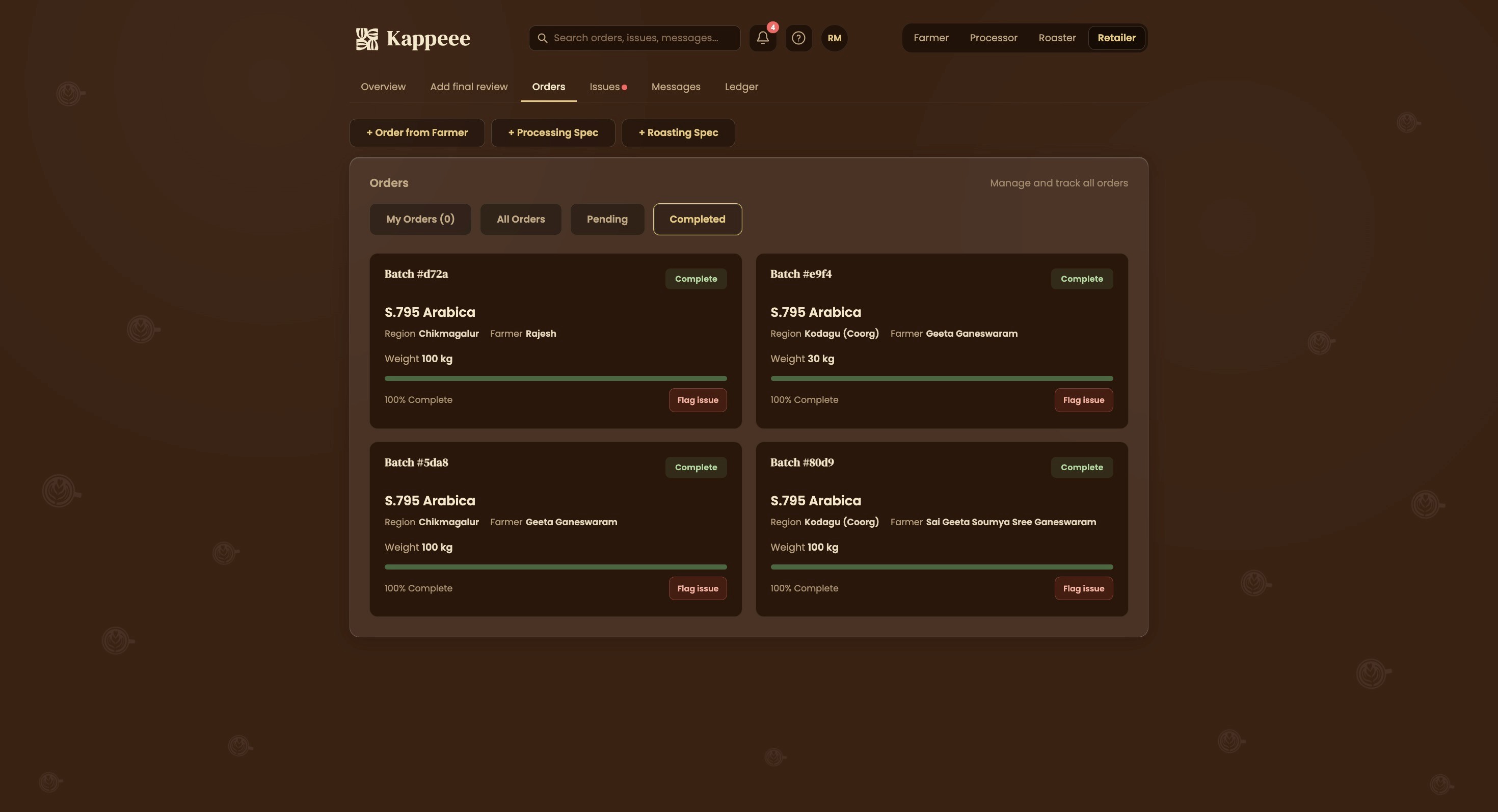


The farmer-facing version of Kappeee is a mobile-first progressive web app — designed to work in low connectivity environments.
Additional Features of Kappeee for Farmers:
It has Kannada language support. Help materials built in.
Field Officer feature — a named, contactable support person assigned to each farming zone who can visit, train, and assist. FPOs can also input data on behalf of the farmers under them.
mAKING kappeee Accessible for farmers


For Consumers: They can scan the QR code on the back of their coffee and see the whole journey of the bean to cup
Traceability QR for Coffee Consumers

The system on ground:
SYSTEM BLUEPRINT


TARGET MARKET ANALYSIS
08/ Designing the system

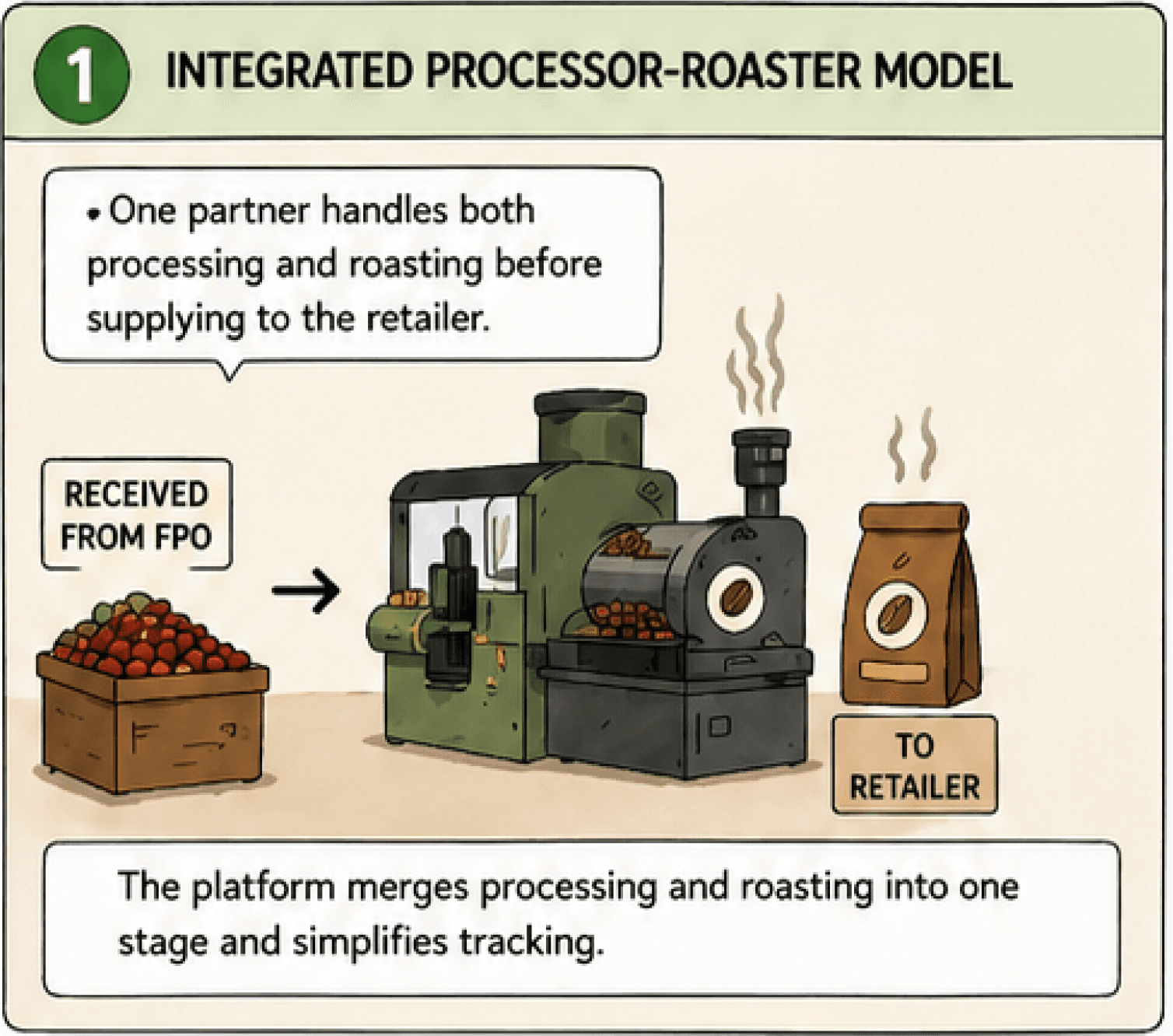
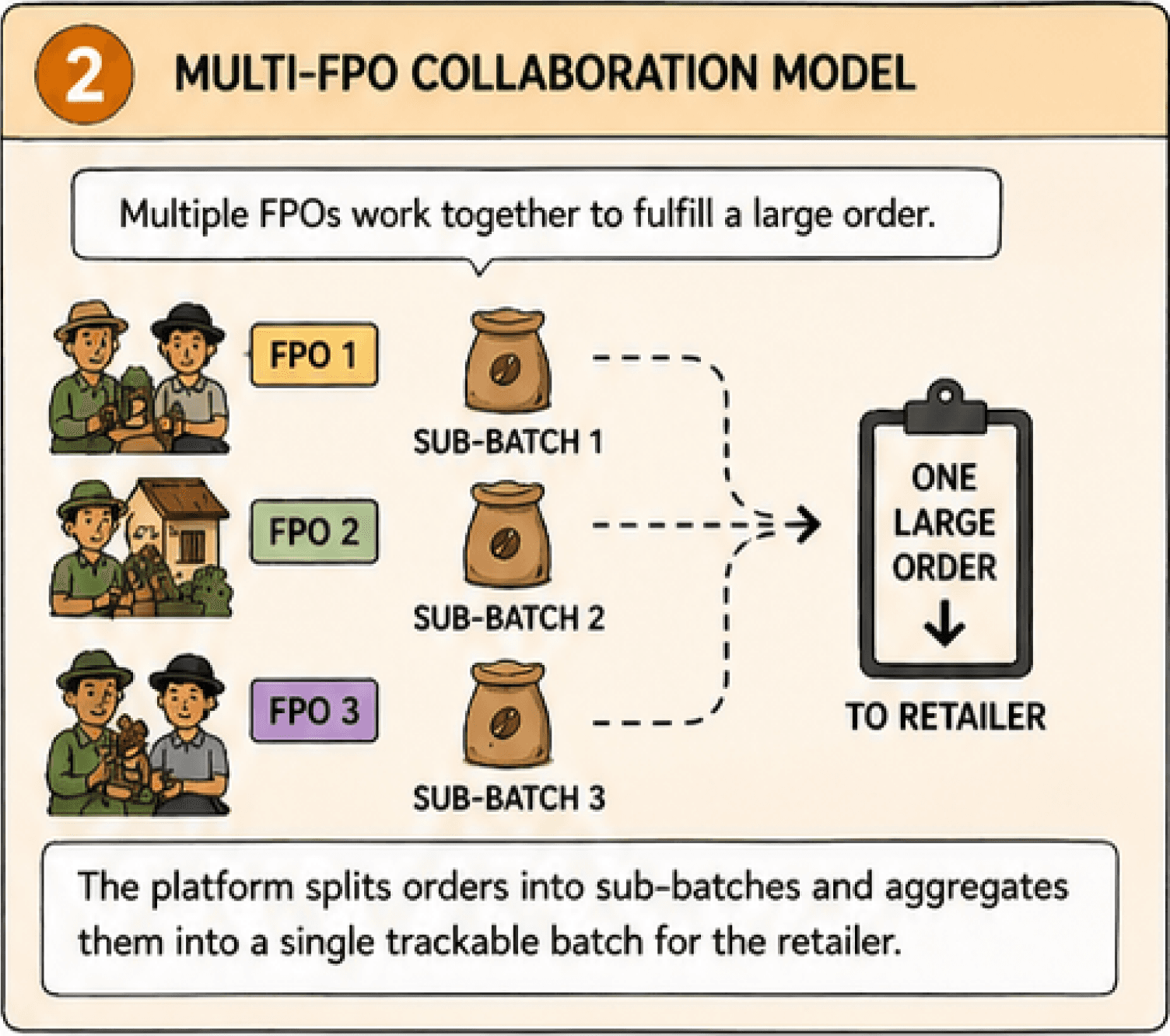
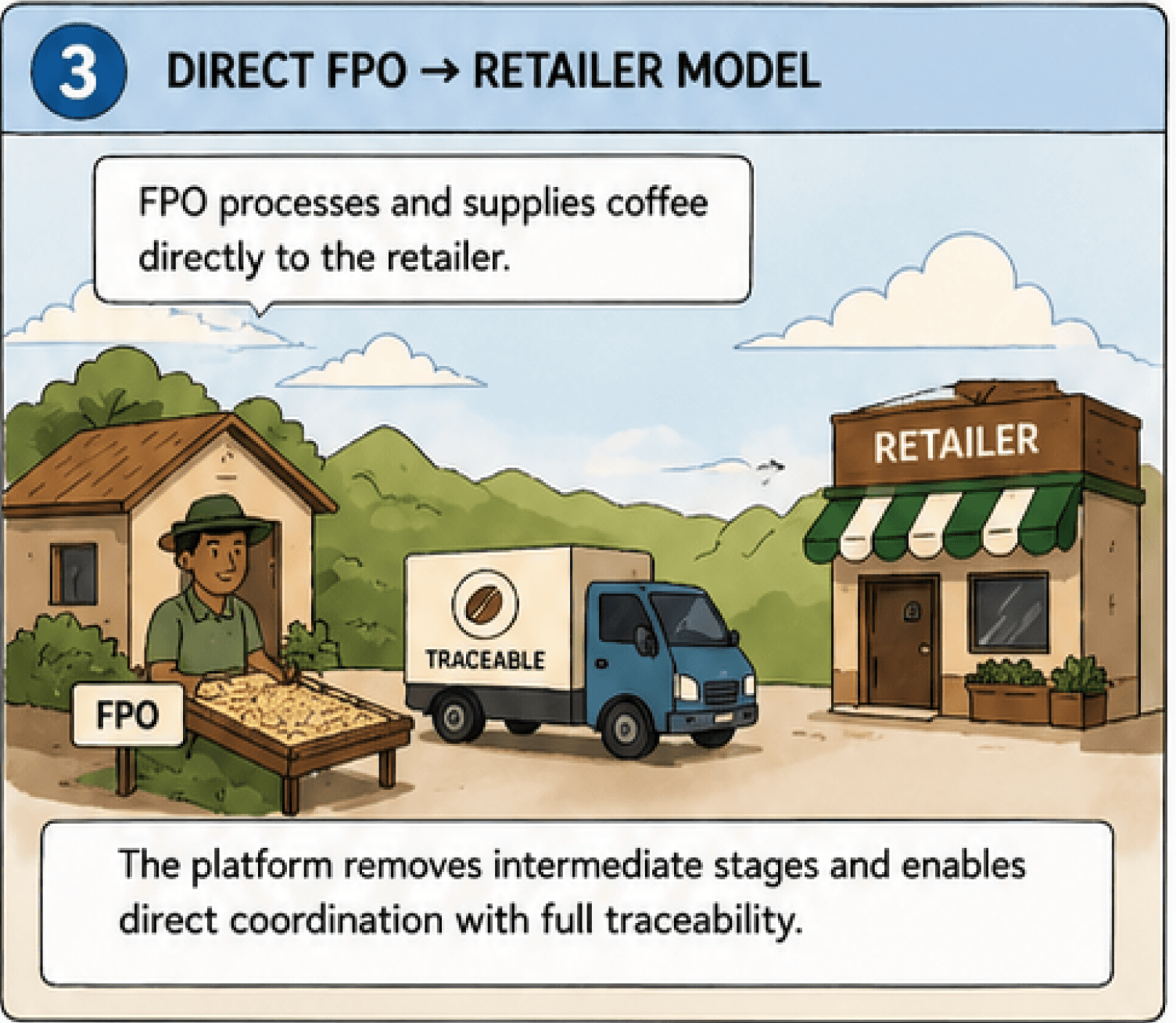

It will be a flexible SaaS model that can be tailored to different retailers' exisiting supply chain practices
aRCHITECTURE DIAGRAM + Use Case Scenarios

Roadmap to build the system

Feasibility, Viability, Usability & Desirability Analysis
09/ Designing the experience


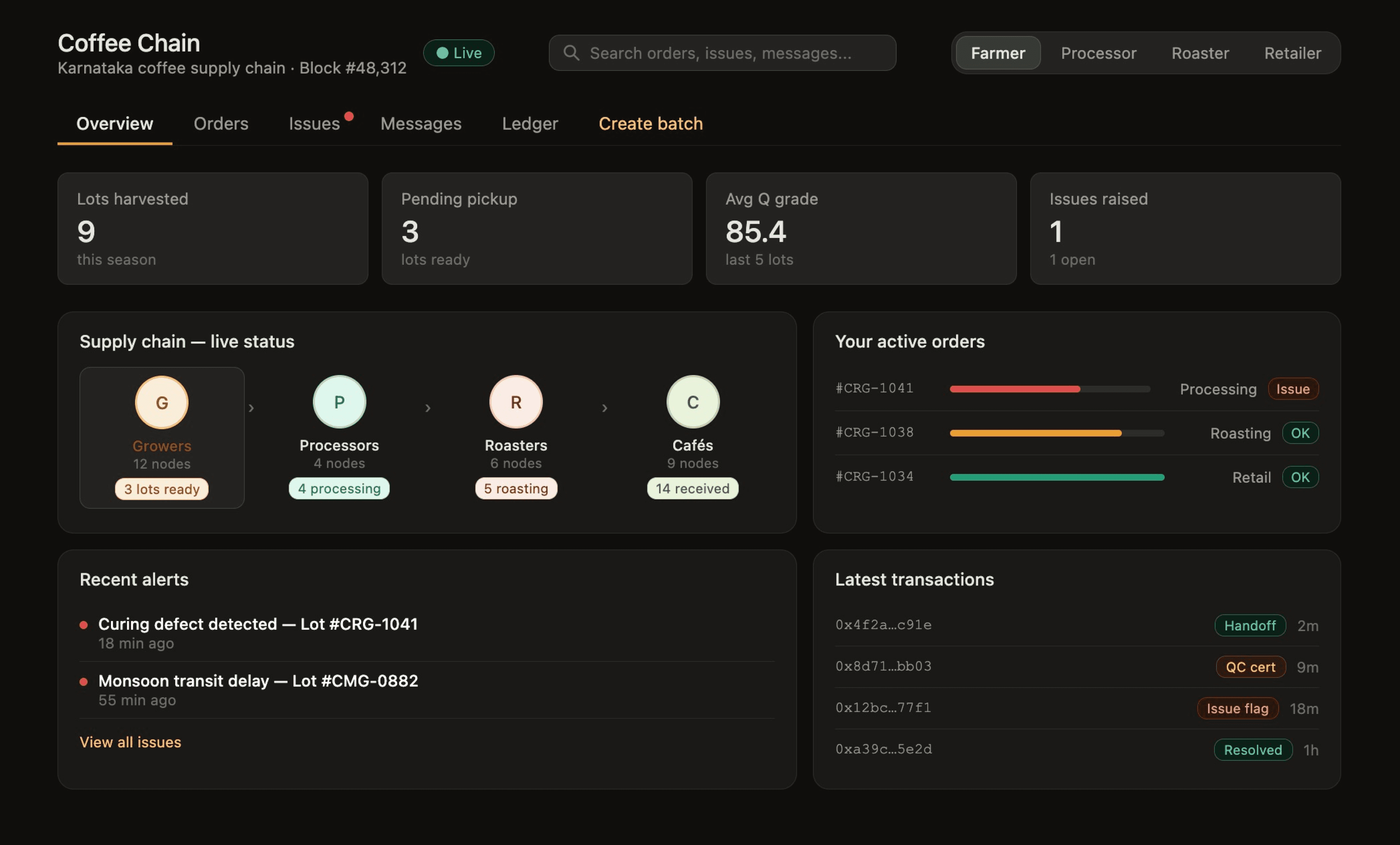


Information Architecture
Sketchs
Vibe Coded Prototype
Final UI Concept
UI colour changes based on the colour the respective stakeholder sees the coffee at their stage
Final Prototype
From Sketchs to platform
Brand vision
Logo
Brand Values
To create a transparent and coordinated coffee supply chain where every stakeholder—from farmer to retailer—can access, trust, and act on shared data to improve quality, efficiency, and fairness.
Transparency
Rooted
Togtherness
Trust
Brand Archetypes
Colour scheme
The Sage
The Everyman
Farmer
Processor
Roaster
Retailer
Kappeee
Four coffee = Four Stakeholders brought together and connected in collaboration
made by many, seen by all
Branding
10/ TESTING THE SYSTEM
What Worked:
What can be Worked upon:
Good that you have an app and solutions for farmers' access
UI concept is really appreciated, UI is clear to understand
Map out what information is accessible for everyone and evaluate if retailers would be okay with sharing that
Great first step. It’s good that the platform can be tailored according to retailer
It's good that users can contact from the platform directly
Find ways to flesh out how to address data tampering at source, and the implentation of that may work
Good Methodology to give farmers more visibility
Coffee Board has been looking into initiatives like this to create a fairer market space
Training and teaching farmers would be essential for success in this, adoption will be slow, but will good in longer run
What do Coffee Stakeholders think of Kappeee?
10/ Measuring change
AFTER:

BEFORE:
Fragmented data silos and disconnected manual records
Heavy reliance on WhatsApp, phone calls, and emails
Issues detected only later on in the chain (2-3 weeks)
High delays, inefficiencies, and coordination challenges
Farmers and FPOs have little to no visibility into downstream processing and feedback
All stakeholders on one shared platform with better collaboration
Immutable single source of truth for the entire supply chain
Early real-time problem detection and collaborative resolution
Significantly reduced delays, inefficiencies, and disputes
Farmers and FPOs gain meaningful visibility into the full supply chain journey
IMPACT OF KAPPEEE

Future SCOPE
11/ Documentation & Exhibtion
Project Docbook


I exhibited my project at the Srishti Manipal Collective 2026, where I had the opportunity to present my findings and platform, engage with visitors, and gather perspectives on my work.
the exhibition
11/ Reflection
WHAT I LEARNT AS A DESIGNER

Go Beyond the Obvious: Comparing what exists on paper with what happens in reality, and validating assumptions with stakeholders on the ground, helped me develop a more grounded understanding of the system.
Embrace the Technical Unknown: This project pushed me into unfamiliar territory. I learnt the fundamentals of coding and experimented with AI-assisted development tools to build a working platform and backend. It was challenging, but constant iteration, persistence, and trusting the process helped me turn an unfamiliar skill into a tangible outcome.
Design for Adoption, Not Just Execution: I learnt that building a solution is often easier than getting people to adopt it. A successful intervention needs to account for the small, human factors that shape behaviour, trust, accessibility, and willingness to change.